

Blog
Desk Job, Aching Back and Neck? How SoftWave Therapy Helps Glendale Professionals

Desk Job, Aching Back and Neck? How SoftWave Therapy Helps Glendale Professionals
If you spend your workday in a chair, whether you are commuting into Glendale for meetings, working from a home office in Montrose, or splitting time between a laptop and a long drive on the 210, you already know the toll it takes. A stiff neck by lunchtime. A dull ache low in your back by 4 p.m. Shoulders that feel like they are permanently hiked up around your ears. This is not just "getting older." It is what happens when a body built to move spends eight or more hours a day folded into the same seated position.
At Health Edge Sports & Spine in the Glendale and La Crescenta area, Dr. Armen Manoucherian and the team see this pattern constantly among local professionals, engineers, entertainment industry staff, healthcare workers, teachers, and remote employees who all share the same complaint, a body that hurts in predictable places because of predictable posture. One of the tools Dr. Armen and the team use to help address the soft tissue and inflammation side of this problem is SoftWave Therapy, a non-invasive treatment designed to support the body's own healing and recovery processes without needles, drugs, or surgery.
Why Sitting All Day Hurts More Than People Expect
Sitting for long stretches is not neutral for the body. It is an active stress on soft tissue, joints, and posture, and it tends to create the same handful of problems over and over.
Chronic Low Back Pain
Sitting places sustained pressure on the discs and muscles of the lower back, especially when a chair lacks support or someone leans forward toward a monitor. Over time, the muscles that stabilize the spine become tight, fatigued, and irritated, showing up as that familiar dull, nagging ache.
Tech Neck
Looking down at a phone or leaning toward a screen shifts the head forward of its natural position. Because the head is heavy, even a small forward shift multiplies the load on the neck and upper back muscles that have to work overtime to hold it up. This pattern, often called "tech neck," is a major contributor to stiffness and tension headaches among screen workers.
Tight, Rounded Shoulders and Hip Flexors
Typing and mousing for hours tends to pull the shoulders forward and inward, shortening the chest muscles while the muscles between the shoulder blades become weak and overstretched. Meanwhile the hip flexors sit shortened for hours at a stretch. Left unaddressed, both patterns can pull on the lower back and change the way the pelvis sits, adding even more strain.
Upper Back Tension
Between a forward head, rounded shoulders, and a slouched spine, the muscles of the mid and upper back are often left holding up poor posture for hours on end, which is why so many desk workers describe a tight, knotted feeling between the shoulder blades that never quite releases.
How SoftWave Helps Address the Underlying Soft Tissue Problem
Stretching, ergonomic adjustments, and movement breaks are all genuinely important, and we encourage every patient to build those habits. But when soft tissue has been under chronic strain for a long time, it often needs more than a better chair to recover. This is where SoftWave Therapy comes in.
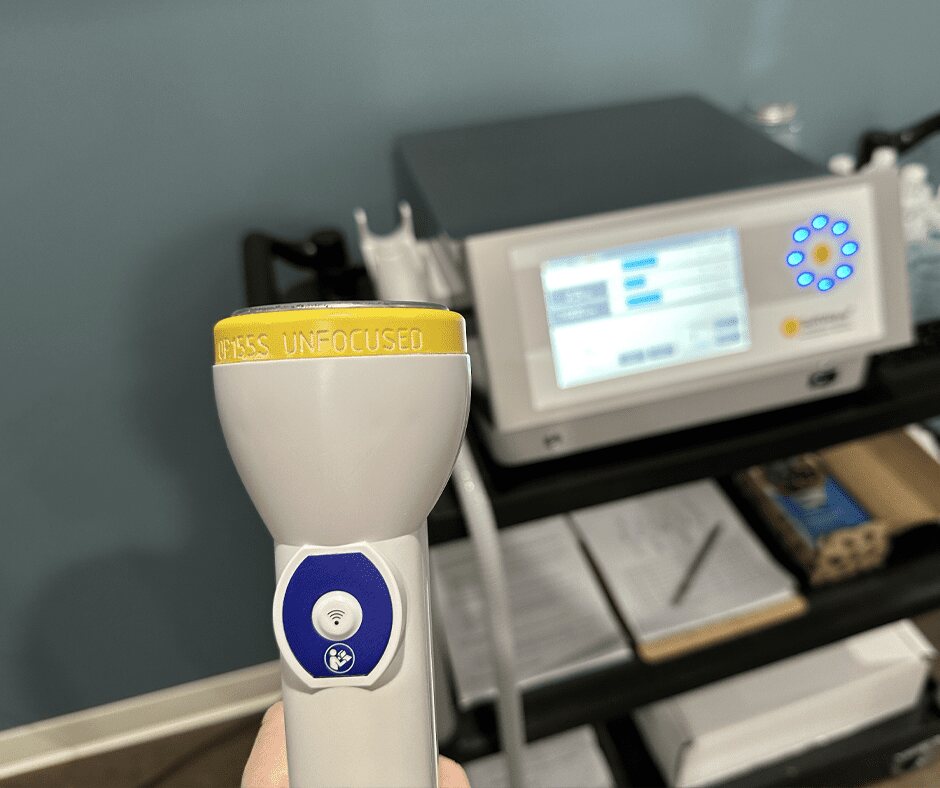
SoftWave TRT is an electrohydraulic shockwave technology that uses a spark generated inside a patented parabolic reflector to create a broad focused acoustic wave. Unlike radial, electromagnetic, or piezoelectric devices, which tend to be shallower or deliver energy to a single point, SoftWave's broad focused wave is designed to penetrate more deeply into tissue to help trigger the body's own natural healing response. In plain language, here is what that process is understood to do:
- Activates resident stem cells: the therapy is designed to stimulate stem cells already present in the tissue and encourage them to migrate to areas that need repair.
- Supports angiogenesis: it may help promote new blood vessel formation, which can improve blood flow to chronically tight or irritated tissue.
- Encourages cell proliferation and collagen: supporting the tissue's own rebuilding process.
- Helps modulate inflammation: often a major driver of the lingering soreness that comes with chronic postural strain.
For a desk worker whose low back, neck, shoulders, or upper back has been under repetitive stress for months or years, this deeper approach is designed to work alongside movement and ergonomic changes, not replace them. Many patients report that combining SoftWave sessions with better desk setup, regular stretching, and movement breaks helps them stay active and comfortable through a long workday.
If a desk job has left your back or neck unable to fully loosen up, it may be time to talk with someone who treats this pattern every day. Schedule a visit with Health Edge Sports & Spine to find out whether SoftWave Therapy fits your recovery plan.
What a SoftWave Session Actually Looks Like
Patients appreciate how simple the experience is. There are no needles, no drugs, and no surgery, and there is no downtime afterward. A typical session takes about 10 to 15 minutes, and most patients complete a series of sessions over roughly 6 to 8 weeks. Many people continue to notice changes for weeks or months after their last appointment, since the biological processes the therapy supports keep working in the background. That makes SoftWave practical for busy professionals, since a short appointment can often fit around a lunch break.
Movement and Ergonomics Still Matter
SoftWave is not a substitute for good habits, and Dr. Armen and the team will be the first to say so. Addressing the soft tissue and inflammation side of desk-related pain works best when paired with practical changes such as:
- Setting a reminder to stand, stretch, or walk for a few minutes every hour.
- Adjusting monitor height so the screen sits at eye level instead of encouraging a forward head position.
- Choosing a chair, or a cushion, that supports the natural curve of the low back.
- Taking short walking breaks during phone calls when possible.
- Doing simple hip flexor and chest stretches to counter the shortening that comes from long sitting.
Combining these habits with a treatment plan that addresses the underlying tissue and inflammation can make a real difference in how a body feels at the end of a workday.
Who Tends to Benefit
Every patient is different, but good candidates for this soft tissue focused approach usually share a few things in common: pain that is more of a chronic, nagging ache than a sudden injury, discomfort that builds across the workday, and tightness that keeps returning even after stretching. Because SoftWave is non-invasive and does not involve medication, it can also suit people who prefer a drug-free approach, or who want to add another tool alongside chiropractic care or physical therapy. SoftWave has been studied at leading institutions and is used by clinicians who work with professional and collegiate athletes, a different kind of "athlete" than the Glendale professional putting in long hours at a keyboard, but the same soft tissue. Chronic low back pain, tech neck, tight shoulders, hip flexor tension, and that stubborn knot between the shoulder blades do not have to be accepted as the permanent cost of a desk job.
Ready to Take the Next Step?
If long days at a screen have left your back, neck, or shoulders tight and sore, a conversation with our team is a good place to start. Let's talk about how SoftWave Therapy and a few practical habit changes could help you feel better through the workday and beyond.
Request your SoftWave Therapy new patient visit online today
Contact Health Edge Sports & Spine
Health Edge Sports & Spine
2600 Foothill Blvd, Suite 203
La Crescenta, CA 91214
Phone: (818) 724-4352
Our Main Office Website: https://healthedgela.com/
‹ Back