

Blog
SoftWave Therapy vs. Cortisone Injections: A Side-by-Side Look for Glendale Patients

Cortisone Shot or SoftWave Therapy? What Glendale Patients Should Know Before Their Next Appointment
If you have been living with a nagging joint or tendon problem, chances are someone (maybe even a previous doctor) has already suggested a cortisone injection. It is one of the most common recommendations in orthopedic and sports medicine, and for good reason: it can work quickly. But quickly is not the same as completely, and many Glendale patients eventually find themselves asking whether there is an option that addresses the problem itself rather than just quieting it down for a while.
At Health Edge Sports & Spine in La Crescenta, Dr. Armen Manoucherian and the team see this question often. Patients want relief, but they also want to understand what is actually happening in the tissue, not just what is happening to their pain level. That is where SoftWave Tissue Regeneration Therapy (SoftWave TRT) enters the conversation as a non-invasive, drug-free alternative worth understanding side by side with cortisone. This article is meant to help you weigh both options with clear eyes, not to tell you cortisone is bad or that SoftWave is a miracle cure. Neither is true. Used appropriately, each has a role. The goal here is simply to explain how they differ so you can have a more informed conversation with your provider.
What Cortisone Injections Actually Do
Cortisone is a corticosteroid, a powerful anti-inflammatory medication. When injected directly into or around a joint, tendon, or bursa, it can substantially calm local inflammation and reduce pain, sometimes within a few days. This is genuinely useful in certain situations: a flare-up that needs to settle down quickly, an acute bout of bursitis, or a joint that is so inflamed that other treatments simply cannot be tolerated yet.
The key thing to understand is what cortisone is not designed to do. It does not repair a torn tendon, rebuild degenerated cartilage, or strengthen weakened connective tissue. It works on the inflammatory response, not on the underlying structural problem. Once the medication wears off, if the tissue itself has not changed, the original condition is often still there underneath, which is why pain can gradually return.
There is also a well recognized concern in the medical community about repeated cortisone injections into the same area over time. Because corticosteroids can affect collagen and local tissue quality with cumulative use, many orthopedic providers are cautious about how often they will inject the same joint or tendon, and some conditions (like certain tendon injuries) are treated more conservatively with cortisone for exactly this reason. None of this means cortisone is unsafe when used thoughtfully and sparingly. It simply means it is best understood as a short-term tool for calming symptoms rather than a long-term strategy for healing.
What SoftWave Therapy Is Designed to Do Differently
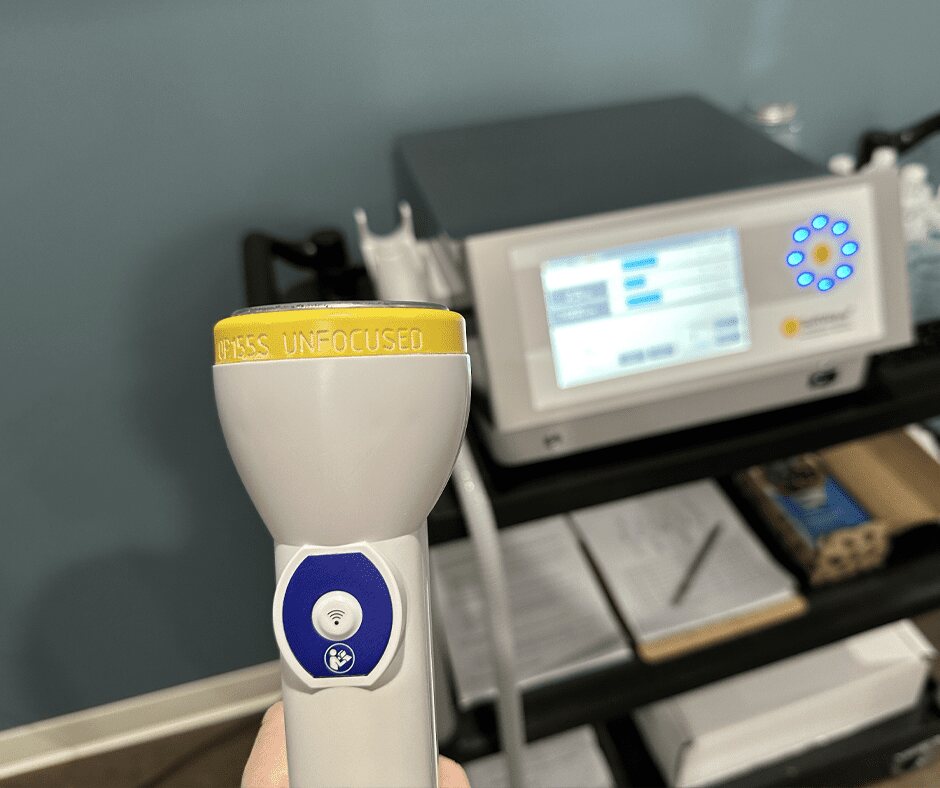
SoftWave TRT takes a fundamentally different approach. Instead of suppressing inflammation with medication, it uses electrohydraulic, broad-focused acoustic waves, generated through a patented parabolic reflector, to reach deep into affected tissue and stimulate the body's own natural healing processes. Unlike radial, electromagnetic, or piezoelectric shockwave devices that treat more superficially or at a single focal point, SoftWave's broad-focused wave pattern is built to engage a wider zone of tissue at meaningful depth.
Rather than numbing or reducing a symptom from the outside, SoftWave is intended to trigger a response from within. There are no needles, no injected drugs, and no surgery involved, and sessions typically run about 10 to 15 minutes. Most treatment plans involve a series of sessions over roughly 6 to 8 weeks, since the biological healing process it is designed to support continues to unfold for weeks and even months after the final session, not all at once in the treatment room.
How SoftWave Helps the Body Heal Itself
The mechanisms behind SoftWave are grounded in how living tissue naturally responds to targeted mechanical stimulation. In plain language, here is what the therapy is designed to encourage:
- Resident stem cell activation: the acoustic waves are designed to stimulate the body's own local stem cells and encourage them to migrate to the area that needs repair.
- Angiogenesis: new blood vessel formation is promoted, which is meant to improve circulation and deliver more oxygen and nutrients to struggling tissue.
- Cell proliferation and collagen support: the therapy is intended to encourage the tissue building blocks involved in stronger, healthier connective tissue over time.
- Inflammation modulation: rather than blocking inflammation entirely, SoftWave is designed to help regulate it as part of a normal, productive healing cycle.
SoftWave technology has been studied at leading academic and research institutions, and it is used by clinicians who also work with professional and collegiate athletes, populations that generally cannot afford to mask a problem instead of resolving it. The FDA has cleared SoftWave for specific uses, including activation of connective tissue, temporary increase of local blood flow, temporary relief of minor muscle and joint pain, treatment of chronic diabetic foot ulcers, and treatment of acute second-degree burns. As with any therapy, results vary from person to person, and SoftWave is not a guaranteed cure for every condition.
Side by Side: When Each Might Be Considered
Cortisone may make sense when inflammation is severe and rapid symptom control is the priority, when a patient needs short-term relief to get through a specific event or window of time, or when other conservative options have not yet been fully explored. It is a tool, and like any tool, timing and frequency matter.
SoftWave tends to appeal to Glendale patients who are looking further down the road: those who have already tried a cortisone shot and found the relief temporary, those who are wary of repeated injections into the same tendon or joint, and those who would simply prefer to start with a non-invasive option that is designed to work with the body's own repair systems rather than around them. It also appeals to patients managing chronic, nagging issues such as plantar fasciitis, tennis elbow, shoulder pain, or knee discomfort, where the underlying tissue quality is really the crux of the problem.
Neither option replaces a proper evaluation. The right path depends on your specific diagnosis, your history, and your goals, which is exactly the kind of conversation Dr. Armen and the team are equipped to have with you.
If you have already tried a cortisone injection and are wondering what a more regenerative-focused option might look like for your specific situation, reach out to schedule a consultation and get a clear, honest assessment of your options.
Making an Informed Decision With Your Provider
This comparison is not about declaring a winner. Cortisone remains a legitimate, well established medical tool. SoftWave is a newer, non-invasive option that many patients choose specifically because it avoids needles, medication, and downtime, and because it supports the body's own tissue repair rather than temporarily silencing a symptom. Some patients use both approaches at different points in their care, depending on the stage of their condition.
What matters most is understanding the difference between calming a symptom and supporting genuine tissue healing, and bringing that understanding into your next conversation with your provider. A thorough evaluation and a clear-eyed look at what each treatment can and cannot do will serve you better than choosing based on which option sounds faster or more familiar.
Ready to Take the Next Step?
If repeated cortisone shots have left you looking for an option focused on healing rather than temporary relief, a SoftWave consultation can help you understand whether it is a fit for your condition.
Request your SoftWave Therapy new patient visit online today
Contact Health Edge Sports & Spine
Health Edge Sports & Spine
2600 Foothill Blvd, Suite 203
La Crescenta, CA 91214
Phone: (818) 724-4352
Our Main Office Website: https://healthedgela.com/
‹ Back