


Blog
What to Expect at Your First SoftWave Discovery Day in Glendale
What to Expect at Your First SoftWave Discovery Day in Glendale
Trying a new therapy for the first time can feel like a leap, especially when it involves technology you have never seen up close. If you are considering SoftWave Tissue Regeneration Therapy (TRT) and wondering what actually happens during that first visit, you are not alone. Many Glendale area patients arrive with the same questions: Will it hurt? How long does it take? What happens afterward? At Health Edge Sports & Spine, Dr. Armen Manoucherian and the team have built a first visit process, often called a Discovery Day, designed to answer those questions before you ever step onto the treatment table.
Walking In: The Welcome and Check-In
Your first visit starts the way most good medical appointments should: with a conversation, not a rush. When you arrive at the La Crescenta office, expect a warm welcome from the front desk team, a few minutes to settle in, and some basic paperwork if you have not already completed it online. Nobody is going to hand you a device and start treating you the moment you walk through the door. The goal of this stage is simply to get you comfortable and make sure the team has an accurate picture of who you are and why you are there.
The Consultation and Health History
Once you are checked in, you will sit down with a member of the clinical team for a consultation. Expect to talk through your health history, including any past injuries, surgeries, chronic conditions, or medications that could be relevant. You will also describe your current problem in detail: where it hurts, how long it has been going on, what makes it better or worse, and what you have already tried, whether that is rest, physical therapy, medication, or other treatments.
This part of the visit matters more than it might seem. SoftWave TRT is not a one-size-fits-all treatment, and Dr. Armen and the team need a clear picture of your situation before recommending it, or before ruling it out for a condition where it is not the right fit.
The Functional Exam
After the consultation, expect a hands-on functional exam. This typically involves testing range of motion, checking strength and stability, and gently palpating the affected area to locate exactly where the trouble is coming from. If your issue is a stiff shoulder, an aching knee, or a nagging spot in your lower back, this is where the team narrows in on the specific tissue that needs attention rather than just the general region. The exam also helps rule out anything that would need a different kind of care first, since not every condition is a good candidate for SoftWave TRT.
How SoftWave Helps Once a Treatment Area Is Identified
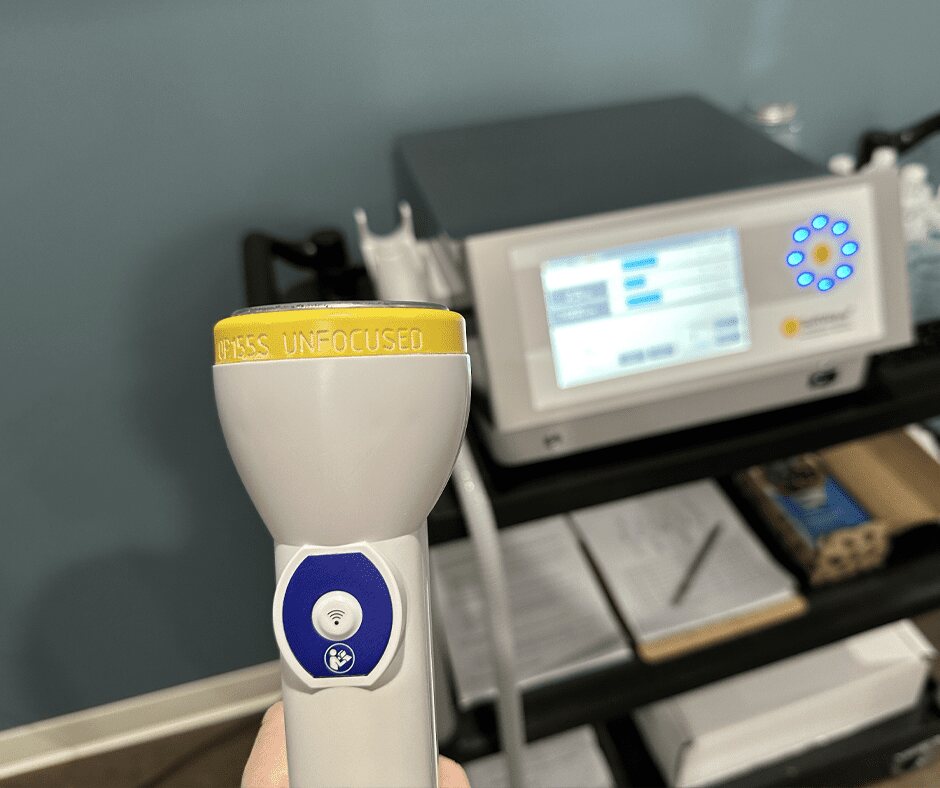
If the exam confirms that SoftWave TRT is a reasonable option, it helps to understand what the technology is doing. SoftWave is an electrohydraulic, spark-generated acoustic wave therapy delivered through a patented parabolic reflector, which makes it broad-focused rather than shallow or single-point like some radial, electromagnetic, or piezoelectric devices. That broad, deep-penetrating wave pattern is designed to reach into tissue from outside the body and stimulate healing processes your body already has.
- Resident stem cell activation: the acoustic waves are designed to stimulate stem cells already present in your tissue and encourage them to migrate toward the area that needs repair.
- Angiogenesis: the therapy may encourage the formation of new blood vessels, which can help improve blood flow to the treated area.
- Cell proliferation and collagen support: increased cellular activity and collagen production are among the responses the therapy is designed to support.
- Inflammation modulation: the treatment is intended to help modulate the inflammatory response in the area being treated.
None of this happens instantly. It is a biological process, and understanding that going in helps set realistic expectations for the weeks ahead.
What the Applicator Actually Feels Like
This is usually the question patients care about most, so let's be direct about it. The SoftWave applicator delivers a series of rapid acoustic pulses to the treatment area, and most patients describe the sensation as a firm tapping or pulsing feeling on the skin. It is not a shock, and there are no needles involved. Some spots feel more sensitive than others, and it is common for the practitioner to find a tender or sore point during the session, sometimes one you did not even realize was the true source of your discomfort. That sensitivity is useful information, since it often confirms the treatment is reaching the right tissue.
A typical session runs about 10 to 15 minutes, short enough to fit into a lunch break or a quick stop on the way to work. There is no sedation and no numbing, and most patients find the sensation manageable, with the practitioner able to adjust intensity if a spot feels like too much.
After the Session: No Downtime, Real Talk About What Comes Next
One of the most reassuring parts of SoftWave TRT is what happens when the session ends: essentially nothing dramatic. There is no incision to care for, no bandage, no restricted activity list, and no recovery period. Most patients get up from the table and go right back to their day, whether that means returning to work, picking up the kids, or heading to the gym. Some people notice mild, temporary soreness in the treated area afterward, similar to how a muscle might feel after a workout, but this typically resolves quickly.
Before you leave, expect the team to walk you through a personalized plan. SoftWave TRT is not usually a single-visit fix. Most plans involve a series of sessions spread out over roughly 6 to 8 weeks, with the exact number and frequency depending on your specific condition and how your tissue responds. This is also the point where Dr. Armen and the team will set realistic expectations directly: healing is a process, not an event, and many patients continue to notice changes for weeks or even months after their final session, since the biological mechanisms the therapy supports keep working in the background long after you leave the office.
Ready to see what your first visit would look like in person? Scheduling your Discovery Day at Health Edge Sports & Spine is the most direct way to get an honest assessment of your situation and find out whether SoftWave TRT is a fit for you.
Setting Expectations: A Series, Not a Single Fix
It is worth repeating, because it is one of the most common misunderstandings about SoftWave TRT: this is a series-based therapy, not a one-time treatment. Just as the underlying tissue did not become irritated overnight, the biological repair process SoftWave is designed to support takes time to unfold. Patients who understand that timeline from the start tend to feel far more satisfied with the process and the outcome than those expecting a single visit to resolve months of discomfort. Results vary from person to person, and no treatment, including SoftWave TRT, can guarantee a specific outcome. What Dr. Armen Manoucherian and the team can offer is an honest, individualized plan built from your exam and history, with a clear picture of what to expect at each step.
Ready to Take the Next Step?
Knowing what to expect can make that first visit feel a lot less intimidating, and a Discovery Day is the easiest way to find out if SoftWave TRT fits your situation. Let the team walk you through your own personalized plan in person.
Request your SoftWave Therapy new patient visit online today
Contact Health Edge Sports & Spine
Health Edge Sports & Spine
2600 Foothill Blvd, Suite 203
La Crescenta, CA 91214
Phone: (818) 724-4352
Our Main Office Website: https://healthedgela.com/
‹ Back