

Blog
SoftWave vs. PRP and Stem-Cell Injections: A Non-Invasive Alternative in Glendale

Needles or No Needles? What Glendale Patients Are Asking About Regenerative Options
If you have spent any time researching regenerative treatments for joint pain, tendon injuries, or slow-healing soft tissue, you have probably come across platelet-rich plasma (PRP) therapy and stem-cell injections. Both have become popular in sports medicine and orthopedic circles, and both aim to help the body repair itself rather than simply masking pain. But they are not the only path to that goal, and for many Glendale patients, the idea of blood draws and injections is a real barrier. At Health Edge Sports & Spine, Dr. Armen Manoucherian and the team offer an alternative worth understanding: SoftWave Tissue Regeneration Therapy (TRT), a completely non-invasive option that works with no needles at all.
How PRP and Stem-Cell Injections Work
PRP therapy involves drawing a sample of the patient's own blood, spinning it in a centrifuge to concentrate the platelets, and then injecting that concentrated plasma directly into the injured area. Stem-cell injections follow a similar logic but typically involve harvesting cells from bone marrow or fat tissue, processing them, and injecting them into the target site. The idea behind both is to deliver a concentrated dose of healing material exactly where it is needed.
These approaches have a real place in orthopedic and sports medicine, and many patients have had positive experiences with them. They are needle-based procedures, however, which means they involve a blood draw or tissue harvest, an injection (sometimes guided by ultrasound), and the discomfort and small risks that come with breaking the skin. They can also be costly, since harvesting, processing, and injecting material is a more involved clinical process than an external therapy. For some patients, this is a reasonable tradeoff. For others, needles, cost, or the invasive nature of the procedure are enough to make them look for a different option.
Where SoftWave TRT Is Different
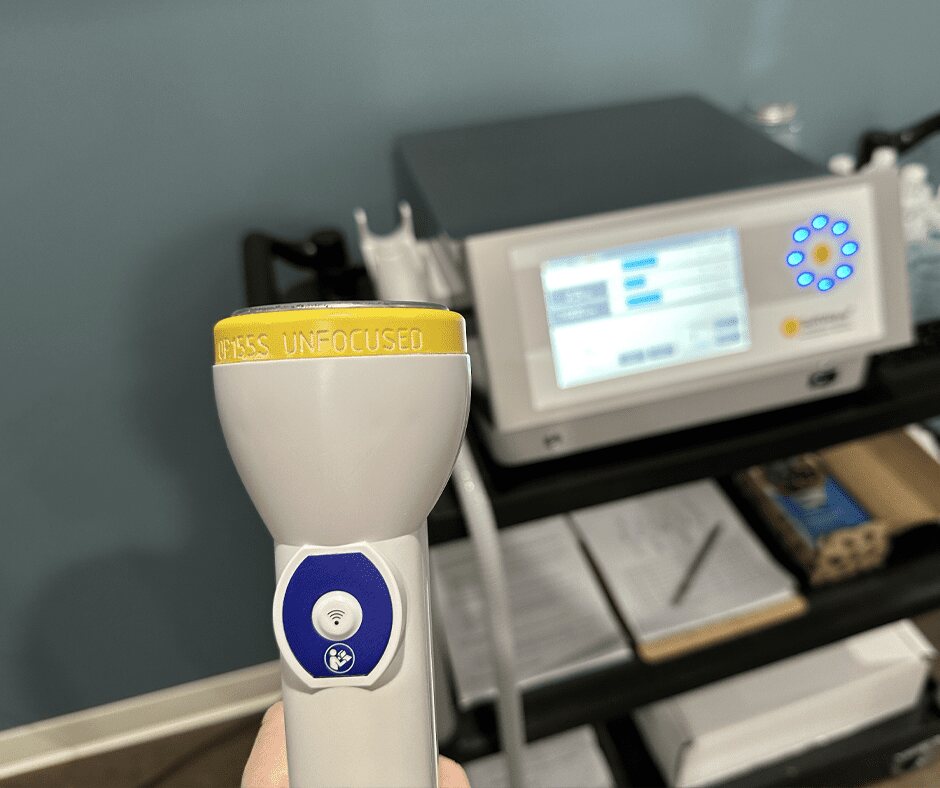
SoftWave TRT does not involve drawing blood, harvesting cells, or injecting anything into the body. Instead, it uses electrohydraulic, spark-generated acoustic waves delivered through a patented parabolic reflector. This is what is known as broad-focused shockwave technology, which sets it apart from radial, electromagnetic, and piezoelectric devices that tend to be shallower or limited to a single focal point. Because the wave pattern is broad and penetrates deeply, SoftWave is designed to reach into the tissue from outside the body and stimulate the healing response that is already present in the patient, rather than adding outside material to it.
In plain terms: PRP and stem-cell injections bring healing material into the body. SoftWave TRT is designed to wake up and direct the healing resources the body already has, using acoustic energy applied externally. Neither approach is inherently "better" for every person or every condition, but they solve the same underlying problem in very different ways, and that difference matters to a lot of Glendale patients weighing their options.
How SoftWave Helps Activate the Body's Own Healing Response
The broad-focused acoustic waves used in SoftWave TRT are designed to trigger a cascade of biological responses in the treated area. Rather than trying to replace what your body can already do, the goal is to encourage your own repair systems to engage more effectively.
- Resident stem cell activation: the acoustic waves are designed to stimulate the stem cells already present in your own tissue and encourage them to migrate to the areas that need repair.
- Angiogenesis: new blood vessel formation may be encouraged, which can help improve blood flow to the treated area.
- Cell proliferation and collagen support: the therapy is designed to support increased cellular activity and collagen production, both important building blocks for tissue repair.
- Inflammation modulation: the treatment is intended to help modulate the body's inflammatory response in the area being treated.
This is the same broad category of biological activity that injection-based regenerative therapies are aiming for. SoftWave simply approaches it from outside the body rather than through a needle.
What a Session Actually Looks Like
One of the most appealing aspects of SoftWave TRT for patients who are hesitant about injections is how simple the experience is. There is no drug, no sedation, no surgical step, and no downtime. A typical session lasts about 10 to 15 minutes, and most treatment plans involve a series of sessions over roughly 6 to 8 weeks. Many patients continue to notice changes for weeks or even months after their final session, since the biological processes the therapy is designed to support continue working in the background.
Compare that to the process behind PRP or stem-cell injections, which typically requires a blood draw or tissue harvesting appointment, processing time, and then an injection visit, sometimes with a recovery period afterward depending on the site treated. For patients juggling work schedules, family obligations, or simply a preference to avoid needles, the SoftWave process can be considerably easier to fit into daily life.
Comparing the Two Paths: Which Fits You?
There is no single right answer here, and being fair to both approaches matters. Injection-based regenerative therapies remain a valuable option, particularly in cases where a clinician determines that direct delivery of concentrated material to a very specific structure is the right clinical strategy. SoftWave TRT is not designed to replace that judgment or any physician's individualized recommendation.
What SoftWave offers is a genuinely non-invasive alternative for patients who want to support their body's own healing cascade without needles, without a blood draw, and often at a different cost structure than a harvesting-and-injection procedure. It is also FDA-cleared for several specific uses, including activation of connective tissue, temporary increase of local blood flow, temporary relief of minor muscle and joint pain, treatment of chronic diabetic foot ulcers, and treatment of acute second-degree burns. The technology has been studied at leading institutions and is used by clinicians who work with professional and collegiate athletes, which reflects a level of interest in acoustic wave therapy as part of a broader regenerative toolkit.
For Glendale area patients dealing with nagging tendon pain, joint stiffness, or a soft tissue injury that has not responded to rest and basic conservative care, it can be worth discussing both options with a provider who offers them. Scheduling a visit with Health Edge Sports & Spine is a straightforward way to find out whether SoftWave TRT, an injection-based approach, or some combination of care makes the most sense for your specific situation.
What to Expect at Your Visit
Dr. Armen Manoucherian and the team at Health Edge Sports & Spine will start with an evaluation of your condition, your history, and what you have already tried. If SoftWave TRT looks like a good fit, they will walk you through what a treatment series would look like, how many sessions are typically recommended, and what kind of timeline is realistic for your situation. As with any regenerative therapy, results vary by individual, and no treatment can guarantee a specific outcome. The goal is to give you an honest, informed option, not a one-size-fits-all promise.
Ready to Take the Next Step?
If the idea of a needle-free path to supporting your body's own repair process appeals to you, it is worth a conversation to see whether SoftWave TRT could be part of your care plan. No pressure, just information tailored to your situation.
Request your SoftWave Therapy new patient visit online today
Contact Health Edge Sports & Spine
Health Edge Sports & Spine
2600 Foothill Blvd, Suite 203
La Crescenta, CA 91214
Phone: (818) 724-4352
Our Main Office Website: https://healthedgela.com/
‹ Back