

Blog
The Science of Shockwave Healing: How SoftWave Activates Your Body's Stem Cells

What Actually Happens Inside Your Tissue During Shockwave Therapy?
If you have heard about shockwave therapy for pain or slow-healing injuries, you have probably heard the results before you heard the reasons. Patients in Glendale talk about stiff shoulders that finally loosen up, or a nagging heel that stops aching after a few weeks. But what is actually going on beneath the skin? The honest answer is that SoftWave Therapy does not "fix" tissue directly. Instead, it sends a mechanical signal that wakes up the body's own repair systems, including resident stem cells, and asks them to get to work.
At Health Edge Sports & Spine in Glendale, CA, Dr. Armen Manoucherian and the team use SoftWave TRT as a drug-free option for patients dealing with chronic joint pain, tendon irritation, and slow-healing soft tissue injuries. Rather than masking discomfort, the goal is to support the tissue's natural ability to remodel and repair itself. Understanding the science behind that process can help you decide whether it is worth exploring for your own recovery.
Broad-Focused Acoustic Waves: Not All Shockwave Devices Are the Same
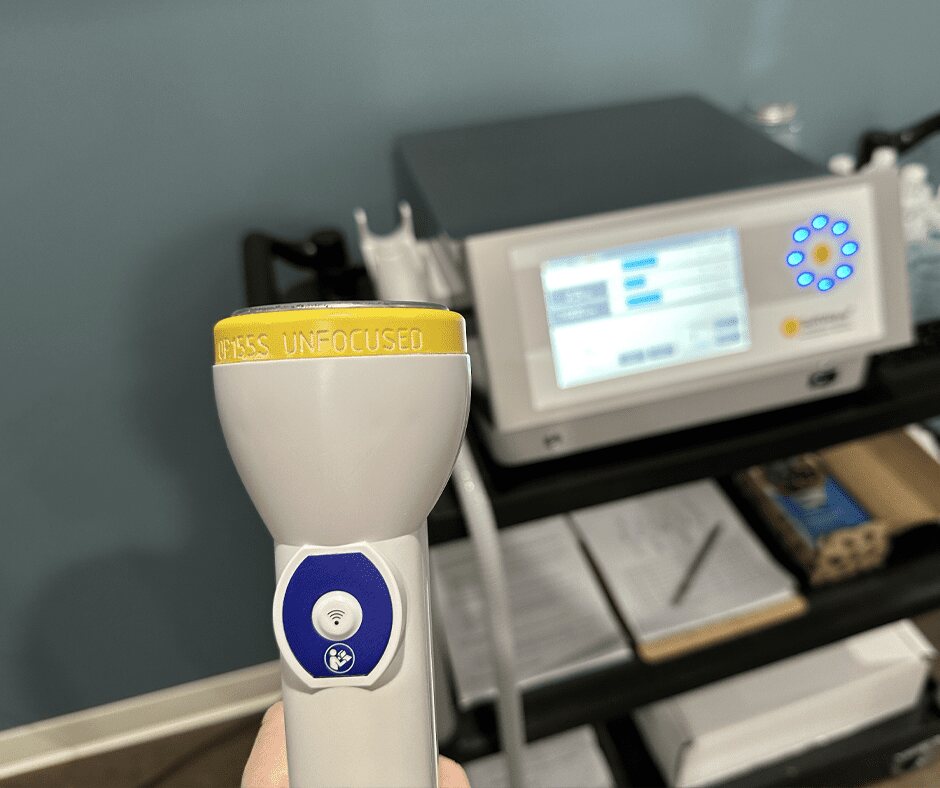
Not all shockwave machines work the same way, and the difference matters. Many devices on the market use radial, electromagnetic, or piezoelectric technology, which tend to deliver energy in a shallow, scattered pattern, or focus it down to a single narrow point. SoftWave TRT is built differently. It uses an electrohydraulic, spark-generated process paired with a patented parabolic reflector to create a broad-focused acoustic wave.
That broad focus is the key detail. Instead of concentrating energy at one small spot near the surface, the wave spreads across a wider area and travels deeper into the tissue, reaching structures like tendons, ligaments, and joint capsules below the skin. This design is part of why SoftWave TRT is often used for problems deeper than surface skin or superficial muscle, without needles, incisions, or anesthesia.
Step One: The Wave Reaches Deep Tissue and Acts as a Mechanical Signal
When the applicator is placed against the skin, the broad-focused wave passes through soft tissue and reaches the target area, whether that is an arthritic knee, a strained rotator cuff, or a stubborn case of plantar fasciitis. The tissue itself does not get cut, heated, or altered directly. Instead, the mechanical energy of the wave acts more like a signal, a physical nudge that tells the surrounding cells something needs attention.
Think of it less like a hammer and more like a wake-up call. Cells in the body constantly sense mechanical forces around them and adjust their behavior in response. SoftWave TRT is designed to take advantage of that sensitivity, using a controlled mechanical pulse to trigger a cascade of biological responses rather than causing new damage.
Step Two: Resident Stem Cells Are Activated and Recruited
One of the most interesting parts of this process involves stem cells that already live in your tissue. These are sometimes called resident stem cells, and they exist in small numbers throughout the body, largely dormant until called into action. Research into shockwave mechanisms suggests that the mechanical signal from a broad-focused wave can help activate these resident stem cells and encourage them to migrate toward the area that needs repair.
In plain terms, the wave does not add anything foreign to your body. It is designed to stir up cells that are already present and direct them toward the site of injury or degeneration, where they may contribute to tissue repair and remodeling over time.
Step Three: Angiogenesis, or New Blood Vessel Formation
Chronic pain and slow healing are often tied to poor local blood flow. Old injuries, overused tendons, and arthritic joints frequently have reduced circulation compared to healthy tissue, which limits how much oxygen and nutrients can reach the area. This is one reason some injuries seem to linger for months or years without improving on their own.
SoftWave TRT is thought to help trigger angiogenesis, the formation of new small blood vessels in the treated area. More blood vessels can mean more oxygen and nutrient delivery to tissue that has been underserved, which may support the repair process and help create a better environment for healing to continue.
How SoftWave Helps Your Body Heal Itself
Put together, the mechanisms behind SoftWave TRT form a sequence, each step building on the one before it. In simple terms, here is what the process is designed to do:
- Deep penetration: broad-focused acoustic waves travel past the surface to reach tendons, ligaments, and joint tissue.
- Cellular activation: the mechanical signal helps activate and recruit resident stem cells toward the treated area.
- New blood vessel growth: angiogenesis may improve local blood flow and oxygen delivery.
- Cell proliferation and collagen support: increased cellular activity may help rebuild and strengthen connective tissue.
- Inflammation modulation: the process is designed to help regulate inflammation rather than simply suppress it.
This is not an instant fix, and it is not magic. It is a series of biological responses that many patients report unfolding gradually, often continuing to improve for weeks or months after a course of treatment ends.
What to Expect During a Session
For patients who are more comfortable with the practical side than the biology lesson, here is what a SoftWave TRT visit typically looks like. Sessions are non-invasive, involve no needles, drugs, surgery, or downtime, and generally last about 10 to 15 minutes. Most treatment plans involve a series of sessions spread over roughly 6 to 8 weeks, since the underlying cellular processes take time to unfold rather than happening all at once.
Many patients describe the sensation as a rhythmic tapping or pulsing rather than anything painful, and most are able to return to normal daily activities immediately afterward. Because the approach relies on the body's own repair mechanisms, results are not guaranteed and can vary from person to person, but the appeal for many is the drug-free, low-downtime nature of the treatment.
Why This Approach Appeals to Glendale Patients
Glendale is full of people who stay active, whether that means hiking in the nearby foothills, playing weekend sports, or keeping up with a demanding job and family life. For many patients, the idea of a treatment option that supports the body's natural healing systems, without surgery or a long recovery period, is appealing. SoftWave TRT has been studied at leading institutions and is used by clinicians who work with professional and collegiate athletes, which speaks to the interest in this kind of regenerative approach across sports medicine.
Of course, SoftWave TRT is not a cure for every condition and is not a replacement for a full medical evaluation. It is FDA cleared for specific uses, including activation of connective tissue, temporary increase in local blood flow, temporary relief of minor muscle and joint pain, treatment of chronic diabetic foot ulcers, and treatment of acute second-degree burns. Dr. Armen and the team can help determine whether your concern is a good fit for this kind of care.
If the science behind shockwave therapy has you curious about whether it could help with your own pain or slow-healing injury, the next step is simple. You can schedule a visit with Health Edge Sports & Spine to talk through your history and find out if SoftWave TRT makes sense for your recovery goals.
Ready to Take the Next Step?
Understanding how SoftWave TRT works is one thing, but experiencing whether it fits your recovery is another. If you are ready to explore a science-backed, drug-free option for your pain or slow-healing injury, our team is here to help.
Request your SoftWave Therapy new patient visit online today
Contact Health Edge Sports & Spine
Health Edge Sports & Spine
2600 Foothill Blvd, Suite 203
La Crescenta, CA 91214
Phone: (818) 724-4352
Our Main Office Website: https://healthedgela.com/
‹ Back