

Blog
What Makes SoftWave Different From Other Shockwave Machines?
Not All "Shockwave Therapy" Is Built the Same: What Glendale Patients Should Know
If you have started researching shockwave therapy for a stubborn shoulder, heel, or knee issue, you have probably noticed that the term gets used for several different kinds of machines. That can make it hard to know what you are actually signing up for. At Health Edge Sports & Spine in the Glendale area, Dr. Armen Manoucherian and the team get this question often: what makes SoftWave TRT different from the shockwave devices patients may have read about or tried elsewhere? The short answer is that not every acoustic wave device is designed to do the same job, and the underlying technology matters a great deal for how deep and how evenly the energy actually reaches the tissue that needs it.
The Three Main Categories of Shockwave and Acoustic Wave Devices
To understand why SoftWave is described as different, it helps to know what else is out there. Broadly speaking, acoustic and pressure wave devices used for musculoskeletal care fall into a few categories, and each one has a distinct way of generating and delivering energy.
Radial Pressure Wave Devices
Radial devices generate a pressure wave using a pneumatic or ballistic mechanism, essentially a projectile striking a transmitter at the tip of a handpiece. The energy then radiates outward from that contact point in a scattered pattern. Because the wave disperses in many directions as it spreads, radial devices tend to concentrate most of their energy near the skin's surface, with intensity dropping off quickly the deeper it travels. This can be useful for very superficial issues, but it also means the energy is distributed unevenly and may not reliably reach deeper structures like tendon insertions or joint capsules.
Electromagnetic and Piezoelectric Devices
Electromagnetic and piezoelectric shockwave devices work differently. Electromagnetic units use a coil and membrane to generate a pressure pulse, while piezoelectric devices rely on crystals that expand when an electric current passes through them. Both approaches are engineered to focus energy toward a single, narrow point in space. That focal precision can be helpful for targeting one specific small spot, but it also means the treatment area covered in any single pulse is quite small. Larger or more diffuse areas of injury may require the practitioner to reposition the device repeatedly to try to cover the full region, and some depth and coverage tradeoffs remain built into the technology itself.
How SoftWave TRT Is Different: Electrohydraulic, Broad Focused Technology
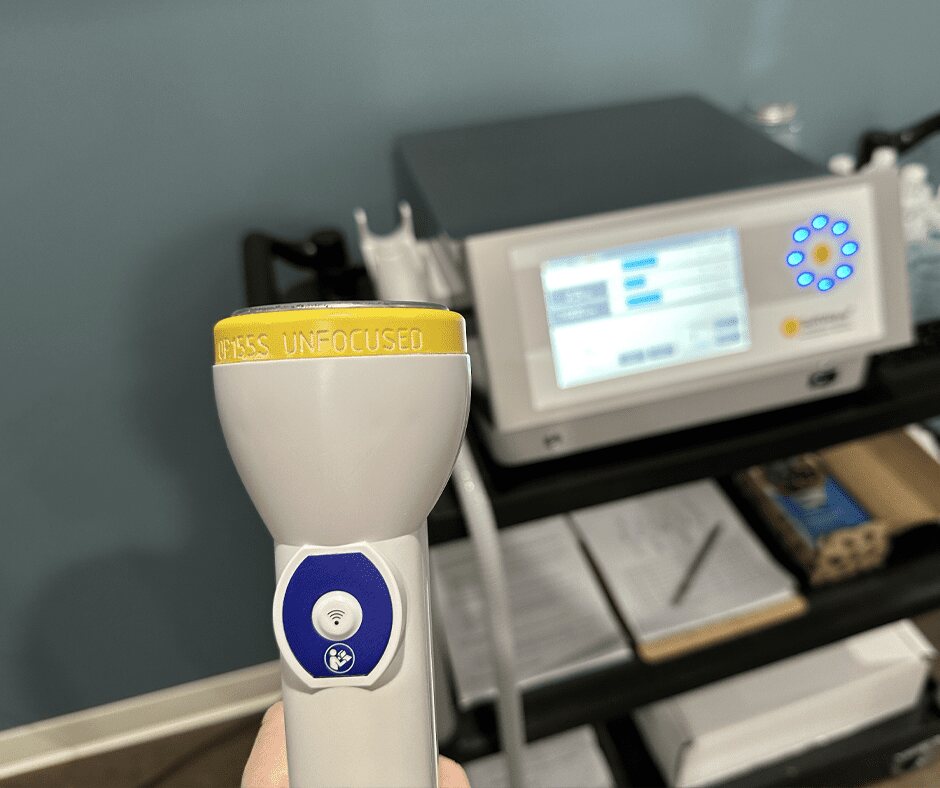
SoftWave Tissue Regeneration Therapy uses a different mechanism entirely. It is electrohydraulic, meaning the wave is generated by an electrical spark discharged within a fluid filled chamber inside the handpiece. That spark creates a true pressure wave, and instead of aiming that energy at a single narrow focal point, SoftWave directs it through a patented parabolic reflector. The reflector's shape spreads the wave into a broad, unfocused pattern that covers a wider area of tissue while still carrying meaningful energy to a deeper level than radial devices are able to reach.
This is why SoftWave is often referred to as the only broad-focused shockwave technology available, as distinct from radial (shallow and scattered), and electromagnetic or piezoelectric (deep but limited to a small point). SoftWave is designed to combine coverage and depth rather than forcing a choice between the two.
Why Depth and Coverage Actually Matter for Healing
Real injuries are rarely confined to a single pinpoint spot. A rotator cuff problem, for example, often involves the tendon, the surrounding bursa, and nearby soft tissue that has adapted to compensate. Plantar fasciitis frequently involves not just one tender point on the heel but a broader area of strain through the arch. When a device can only deliver strong energy to one small point at a time, some of the surrounding tissue contributing to the problem may not get meaningfully addressed.
Depth matters too. Many structures that respond well to acoustic wave therapy, such as tendon attachments, ligaments, and joint capsules, sit below the most superficial layers of skin and fat. A wave that loses most of its energy before reaching that depth may have a harder time triggering the kind of biological response practitioners are hoping for.
How SoftWave Helps Trigger the Body's Own Healing Response
The goal of SoftWave TRT is not to mask pain temporarily. It is designed to reach affected tissue and stimulate the body's own natural healing cascade. In plain language, here is what that process may involve:
- Resident stem cell activation: the acoustic waves are thought to help activate and encourage the migration of the body's own resident stem cells toward the treated area.
- Angiogenesis: new blood vessel formation may be supported, which can improve blood flow to tissue that has been struggling to heal on its own.
- Cell proliferation and collagen support: increased cellular activity and collagen production are part of how tissue rebuilds itself over time.
- Inflammation modulation: the therapy is designed to help modulate the inflammatory process rather than simply suppress it.
Because the broad-focused wave reaches a wider swath of tissue at meaningful depth, more of the affected region has the opportunity to participate in that healing cascade, rather than just the single point a narrow-focus device happens to be aimed at during any given pulse.
What Sessions Are Actually Like
SoftWave TRT is non-invasive. There are no needles, no drugs, no incisions, and no downtime required afterward. A typical session runs about 10 to 15 minutes, and most treatment plans involve a series of sessions spread over roughly 6 to 8 weeks. Many patients report that healing continues to build for weeks or even months after the final session, since the underlying biological response takes time to unfold. This is not a one-and-done fix, and it is not a guarantee of a cure, but it is a structured approach that has been studied at leading institutions and is used by clinicians who work with professional and collegiate athletes.
If you have been comparing shockwave options around Glendale and want a clearer picture of which technology actually fits your situation, you can request a visit with Health Edge Sports & Spine here and get a straightforward, honest answer.
Is Broad Focused Technology Right for Your Injury?
Not every case calls for the same tool. Dr. Armen Manoucherian's approach is to evaluate the specific joint, tendon, or soft tissue issue a patient is dealing with, and discuss whether SoftWave TRT is an appropriate option as part of a broader plan of care. SoftWave is FDA cleared for activation of connective tissue, temporary increase in local blood flow, temporary relief of minor muscle and joint pain, treatment of chronic diabetic foot ulcers, and treatment of acute second-degree burns. It is not positioned as a replacement for medical advice or diagnosis, and it is not marketed as a miracle cure. It is one option, grounded in how the technology is actually engineered, that may help certain patients when applied thoughtfully.
For Glendale area patients who have tried other approaches, including other shockwave machines, without the results they hoped for, understanding the difference between radial, electromagnetic, piezoelectric, and broad-focused electrohydraulic technology can be a useful part of deciding what to try next.
Ready to Take the Next Step?
If you want to understand whether SoftWave's broad-focused, deeper-reaching approach makes sense for your specific injury, the team at Health Edge Sports & Spine can walk you through it in plain language during your visit.
Request your SoftWave Therapy new patient visit online today
Contact Health Edge Sports & Spine
Health Edge Sports & Spine
2600 Foothill Blvd, Suite 203
La Crescenta, CA 91214
Phone: (818) 724-4352
Our Main Office Website: https://healthedgela.com/
‹ Back